Stop Sacrificing Surface Finish to Inefficient Storage.
In the world of precision aluminum extrusions and sanitary stainless profiles, a scratch is not just a blemish—it’s scrap. Traditional floor stacking and forklift “fishing” expeditions are destroying your inventory’s value (Ra) and eating up 50% of your floor space. It’s time to switch to a system designed for Zero-Damage Handling.
The Hidden Cost of “Floor Stacking” High-Value Profiles
If you are managing a metal service center or a fabrication shop dealing with architectural aluminum or hygienic stainless steel (like GHWA), you know the nightmare of the “honeycomb” pile. Your 20-foot extrusions are stacked on the floor. To get to the specific alloy or length at the bottom, your team has to move the top five bundles.
This “double handling” isn’t just a waste of labor hours; it is the primary cause of:
- Surface Degradation: Every time a fork tine slides between bundles, you risk gouging the anodized finish or polished surface.
- Structural Twisting: Improper dunnage spacing on the floor causes long extrusions to bow or twist over time.
- The “FILO” Trap: First-In, Last-Out storage leads to dead inventory burying your cash flow at the bottom of the pile.
The Logic: Why Telescopic Racks Change the Game
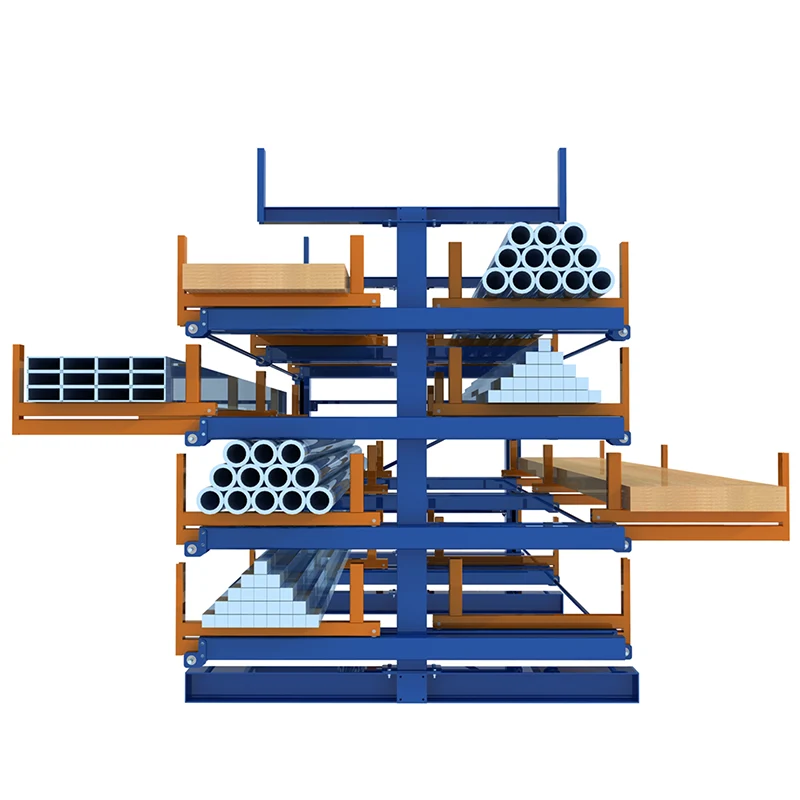
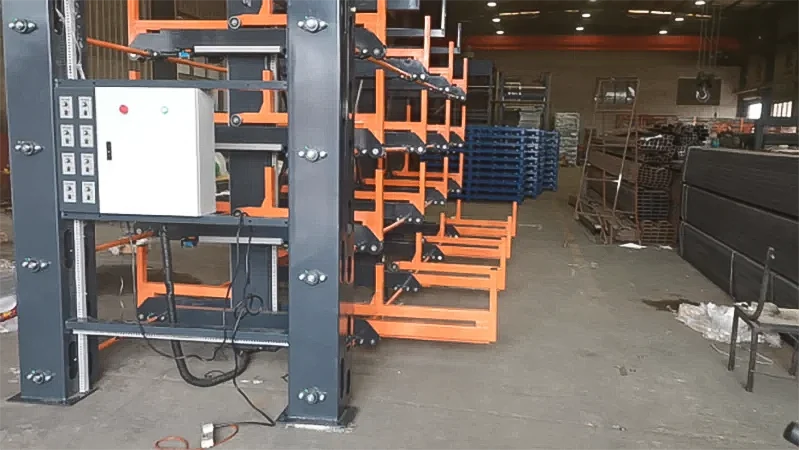
The solution lies in changing how you access the material. An Aluminum extrusion storage rack with telescopic arms (also known as a Crank-out or Roll-out Cantilever) allows you to stop using forklifts for retrieval entirely.
By allowing each storage level to extend 100% out of the rack structure, you open up the material to an overhead crane. This vertical lift method eliminates the lateral friction that causes scratches.
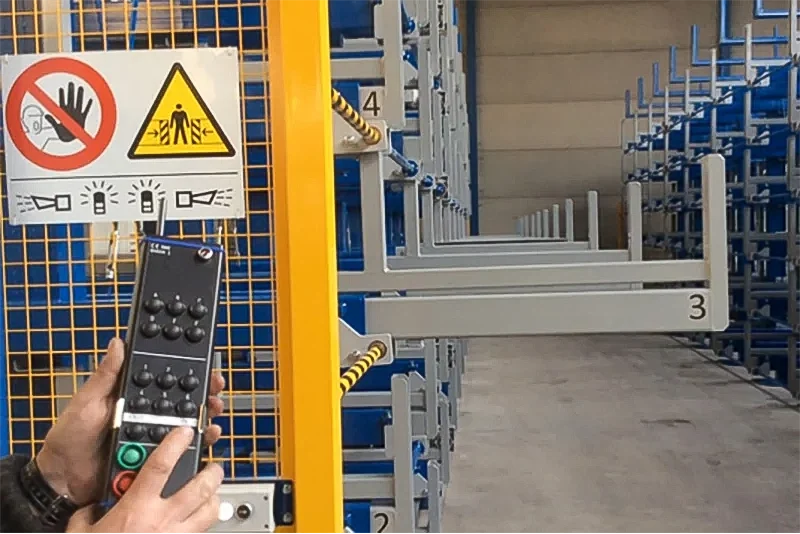
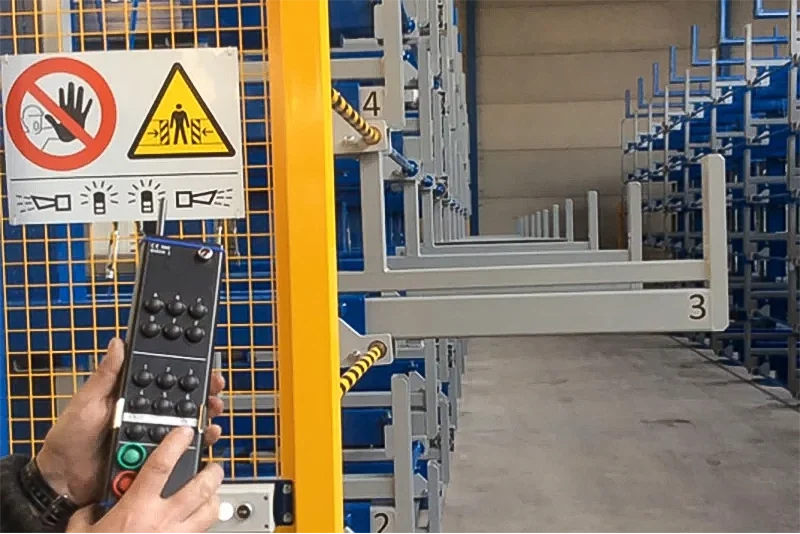
Figure 1: Motorized telescopic arms allow a single operator to access heavy aluminum bundles without a forklift.
1. 100% Overhead Crane Accessibility
Whether you are using a vacuum lifter for delicate sheets or nylon slings for bundles of tubing, the roll out cantilever rack presents the load completely clear of the column. The crane drops straight down, picks the specific bundle, and lifts straight up. Zero side-impact risk. This is critical for maintaining high-purity standards in industries like pharmaceutical or semiconductor component manufacturing.
2. The End of the 4-Meter Aisle
Standard cantilever racks require massive aisles—often 12 to 14 feet wide—just to let a sideloader or forklift turn around. Because our telescopic system utilizes overhead space and cranes, you can slash that aisle width down to mere operator walking space. Facilities often reclaim 50% of their floor area, allowing space for new CNC machines or laser cutters immediately adjacent to the storage.
Engineered for Protection: Specific Features
When storing soft metals like aluminum or high-finish stainless steel, steel-on-steel contact is the enemy. Our Telescopic Cantilever Rack systems can be outfitted to ensure the integrity of your stock:
- UHMW Liners: We can apply Ultra-High Molecular Weight polyethylene strips to the arms and base. This provides a non-marring surface that cushions your extrusions against the steel rack structure.
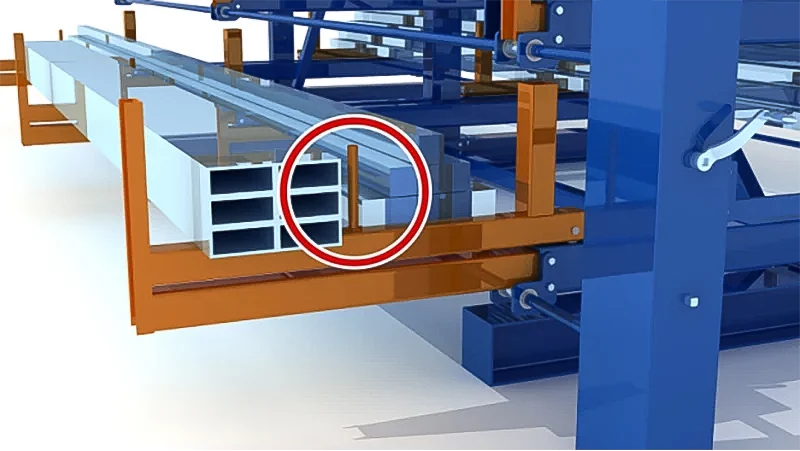
- Adjustable Dividers: (As seen in the image above) Keep different alloys, lengths, or customer orders physically separated within the same level. This prevents “tangled” inventory and speeds up picking for your saw operators.
- Deflection Control: Unlike light-duty shelving, our structural steel I-Beam construction minimizes arm deflection, ensuring your precision profiles stay straight and true, even under loads of 3,000 to 10,000 lbs per level.
Technical Specifications & ROI
Implementing a crank out cantilever rack is not just a storage decision; it is a productivity upgrade. By moving from a 20-minute “hunt and peck” forklift retrieval to a 3-minute crane cycle, you directly increase the uptime of your processing equipment (lasers, saws, CNCs).
| Feature | Specification Range | Benefit for Aluminum/Metal Centers |
|---|---|---|
| Arm Extension | 100% Full Extension | Allows vertical lifting via overhead crane; prevents scratching. |
| Load Capacity | 1,000 – 6,600 lbs per arm pair | Handles dense bundles of solid bar stock or heavy tubing. |
| Material Length | 10 ft to 40 ft (Customizable) | Perfect for standard 20′ or 24′ extrusion lengths. |
| Operation | Manual Crank or Electric Motor | Ergonomic operation; eliminates physical strain on operators. |
Frequently Asked Questions
1. Can these racks handle anodized aluminum without scratching it?
Yes. While the rack structure is steel, we highly recommend and offer optional UHMW (plastic) liners for the arms and base. This ensures your anodized or polished surfaces never touch bare metal.
2. What is the maximum length of aluminum extrusion we can store?
The system is modular. We regularly design racks for standard 20-foot and 24-foot material, but by adding vertical columns, we can accommodate lengths of 40 feet or more while preventing material sagging.
3. Do I need a special forklift to load this rack?
No—in fact, the goal is to stop using forklifts for retrieval. You can use a forklift to load the rack initially if needed, but the primary efficiency gain comes from using an overhead crane (bridge crane) or vacuum lifter to access the fully extended drawers.
4. How much force is required to crank out a fully loaded arm?
Very little. Our geared crank mechanism creates a high mechanical advantage. An operator can extend a drawer loaded with 6,000 lbs of material with just 15-20 lbs of hand force. Electric options are also available for push-button operation.
5. Can we store short remnants and long stock in the same rack?
Yes. We can install intermediate support beams or steel decking/trays on specific arm levels to create a solid shelf. This is ideal for storing cut-offs, short remnants, or irregular fixtures alongside your full-length extrusions.
Need a Custom Storage Solution?
Speak directly with our technical engineers. We offer free structural designs, heavy-duty catalog evaluations, and quick B2B price quotations.
Request a Quote Now →