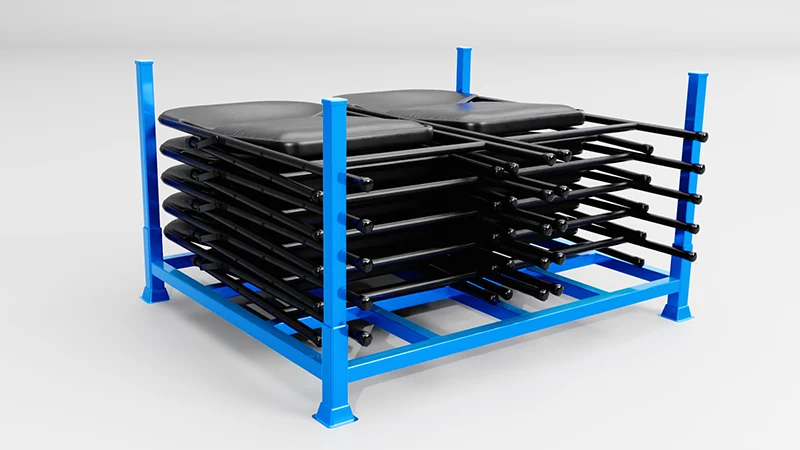

Tired of warped lumber, damaged PVC pipes, and the slow, risky process of handling long-stock materials? Traditional A-frame racks offer limited flexibility and protection, locking your valuable floorspace into a static layout. It’s time to rethink how you store, move, and protect your most challenging inventory.
Storing and moving long-form materials like lumber, steel tubing, or PVC pipe presents a unique set of challenges that standard pallets and shelving simply can’t solve. While A-frame racks have been a common go-to, they are a static solution in a dynamic world. They are fixed to the floor, offer little protection during transit, and do nothing to solve the biggest bottleneck: the slow, manual process of loading and unloading trucks.
This inefficiency leads to hidden costs—product damage from bowing, wasted labor hours, and a warehouse layout that can’t adapt to changing inventory levels.
The Hidden Costs of Traditional Long-Stock Handling
For any operation dealing with materials over 8 feet long, the “Before” picture is painfully familiar. Whether it’s lumber for construction, PVC extrusions, or metal conduits, the challenges are universal and costly.
Before: A Cycle of Damage and Inefficiency
In a typical warehouse, long stock is either stacked on the floor in pyramids or placed in stationary A-frame racks. This leads directly to several problems:
- Product Damage & Yield Loss: Long, flexible items like PVC pipes or wooden trim will sag or bow (“Bowing/Sagging”) if not supported along their entire length. This permanent deformation makes the product unusable, directly impacting your bottom line. Manual handling with forklifts often results in scratches and dents.
- Crippling Labor Inefficiency: Unloading a container of loose pipes or lumber is a grueling, manual task. A team can spend 3-4 hours carefully unloading a single truck, piece by piece. This not only drives up labor costs but also keeps your loading docks occupied for far too long.
- Wasted Vertical Space: Floor stacking is limited by safety and stability, rarely going more than a few feet high. A-frame racks are better but still don’t leverage the full ceiling height of a modern warehouse. You are paying for cubic feet but only using square feet.

A Structural Shift: From Static Holder to Dynamic Logistics Unit
The solution is to change the fundamental logic of how you handle these materials. Instead of moving individual pieces, you move the entire storage unit. This is the core principle behind portable stack racks. Think of it not as a rack, but as a “pallet with a skeleton.”
These engineered steel units consist of a heavy-duty base and four or more removable posts. The load of the materials, and the racks stacked above, is borne entirely by the steel frame, not the product itself. For extra-long materials, specialized 6 or 8-post versions provide intermediate support points, completely eliminating the risk of sagging and product damage.
From Hours to Minutes: Revolutionizing Your Inbound/Outbound
This structural change transforms your workflow. The rack becomes the packaging.
- At the Supplier: Materials are loaded directly into the metal post pallet at the point of production.
- Inbound at Your Dock: A single forklift operator can unload an entire rack—holding up to 4,000 lbs of material—in one go. The entire truck is unloaded in as little as 20 minutes, not 4 hours.
- Outbound to Customer: Simply pick the required rack and load it directly onto the truck. The steel frame protects the product all the way to the job site, ensuring it arrives in perfect condition.

Reclaim Your Warehouse: Go Vertical
Because the racks are engineered for load-bearing, they can be safely stacked 4 or 5 units high. A self-aligning “cup feet” design allows forklift drivers to quickly and securely place one rack on top of another without precise maneuvering. This instantly converts your unused vertical air space into valuable storage, increasing your warehouse capacity by 400-500% without spending a dime on expansion.

The Smart Economics of a Flexible Racking System
While the initial investment in a system of heavy duty stack racks is higher than simple dunnage, the return on investment is rapid and multifaceted. Beyond the immediate labor savings and elimination of product damage, the system solves a major reverse logistics headache.
When the racks are empty, the posts can be removed and stored in the base. The bases are then nested together. This “nestable” design means a return truck can carry 4 to 5 times more empty racks compared to assembled ones, slashing your return freight costs by up to 80% and making a closed-loop, returnable packaging system economically viable.
By shifting from a static A-frame to a dynamic, portable stacking pallet racks system, you’re not just buying a piece of equipment. You are implementing a comprehensive logistics solution that reduces damage, multiplies labor productivity, and maximizes every square foot of your facility.
Frequently Asked Questions
1. Can these racks handle different lengths of lumber or pipe?
Absolutely. The bases of our pallet stacking racks can be manufactured to any length required, from 8 feet to over 40 feet, to perfectly match your product specifications and provide complete support.
2. What is the weight capacity of a single rack?
Standard models typically have a capacity of 2,000 to 4,000 lbs (900 to 1800 kg). However, they are frequently engineered for much heavier applications, such as steel coils or bars, with capacities exceeding 10,000 lbs.
3. Are they suitable for outdoor storage of building materials?
Yes. We recommend a hot-dip galvanized finish for any outdoor application. Unlike paint, this process creates a metallurgical bond with the steel, offering decades of rust-proof performance even in harsh weather conditions.
4. How do the racks stack, and is it safe?
The racks feature a male-female “cup feet” design. The conical bottom of the foot on the upper rack is guided into the top of the post on the lower rack, creating a secure, self-aligning connection that is both safe and easy for forklift operators to engage.
5. How much space do I really save on return shipping?
With the posts removed, the empty bases nest together in a very dense block. Typically, you can fit 4 to 6 nested empty racks in the same space that one fully-loaded rack occupies. This translates to a 75-80% reduction in cubic space required on a return truck.
Need a Custom Storage Solution?
Speak directly with our technical engineers. We offer free structural designs, heavy-duty catalog evaluations, and quick B2B price quotations.
Request a Quote Now →