 |
Your outdoor yard is a critical storage area, but rain and humidity are turning your powder-coated racks into rust factories. Every rust flake is a direct threat to your high-value laminated glass sheets, and the constant cycle of sandblasting and repainting is a drain on your maintenance budget. What if you could eliminate that problem for the next 15 years? |
For glass fabricators, every square foot of the facility counts, including the outdoor yard. It’s often the only practical space for staging raw float glass or finished architectural units. But this cost-effective storage strategy comes with a hidden enemy: corrosion. Standard powder-coated racks might look good on day one, but after a few seasons of rain, forklift impacts, and daily wear, they begin to fail. Chipped paint leads to rust, and that rust isn’t just an eyesore—it’s a direct threat to your bottom line.
Beyond the Sticker Price: The Real Cost of a Rusted Glass Rack
Imagine this common scenario: A worker is loading a large, expensive sheet of Low-E glass onto a rack that’s been stored outside. A small, unseen rust flake from a deteriorating weld transfers onto the glass surface. It’s nearly invisible until after the sheet has been processed and sealed into an Insulated Glass Unit (IGU). Now, you have a high-value, finished product with a permanent defect sealed inside. The cost of that single scrapped IGU, destined for a high-profile architectural project, can easily exceed the cost of the rack it was stored on. This isn’t a “risk”; it’s a recurring operational tax paid for choosing the wrong surface protection.
Powder coating is essentially a plastic film. Once a deep scratch from a forklift tine or a heavy impact breaks that film, the steel underneath is exposed. Corrosion begins immediately, creeping under the coating and blistering out from the compromised area. The welds are always the first to go.

Hot-Dip Galvanization: A One-Time Investment Against a Decade of Headaches
There is a fundamentally better solution. Hot-dip galvanization isn’t a coating; it’s a metallurgical transformation. Here’s why it matters for your glass inventory:
- The Process: We don’t just paint the rack. After fabrication, the entire A Frame Glass steel rack is submerged in a 840°F (450°C) bath of molten zinc.
- The Result: This process creates a series of zinc-iron alloy layers that are metallurgically bonded to the steel. These layers are harder than the base steel itself. The zinc becomes an integral part of the rack, not just a surface layer waiting to be chipped off.
- The Protection: It provides total coverage, inside and out. Every hollow tube, every corner, and every single weld is fully encapsulated and protected. This sacrificial zinc layer will corrode first, protecting the steel for decades, even if it gets scratched.
The result is 15+ years of maintenance-free, rust-proof performance, even in damp industrial yards or salty coastal air. The cycle of repainting is over. The risk of rust contamination is eliminated. Your Total Cost of Ownership (TCO) plummets, and your focus returns to fabricating perfect glass, not maintaining racks.

A Rust-Proof Foundation for a Safer, More Efficient Workflow
A rack that lasts for 15 years must be built on more than just a superior surface. The true value comes when this durability supports a safer and more efficient production flow. While galvanization protects the steel from the elements, our commitment to a Full Welding Process ensures the structure itself won’t fail under load. Unlike inferior spot-welded racks that can tear under the dynamic stress of a 4,000 Lbs pack of toughened glass, our A-frames are engineered for absolute structural integrity, eliminating hazardous “fall shadow” zones in your workshop.
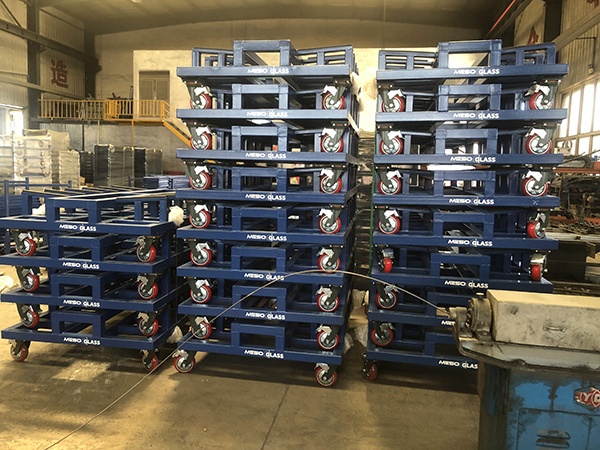
This combined durability means you can confidently use these racks as mobile “WIP” (Work-in-Progress) stations, moving cut glass seamlessly from your CNC glass cutting table to the staging area of your glass tempering furnace. With heavy-duty polyurethane casters, they become an essential tool for creating a lean, agile workflow, reducing your reliance on forklifts and overhead cranes for every internal movement.

Choosing a hot-dip galvanized A-frame is not an expense. It’s a strategic investment in lower maintenance, zero product contamination risk, and long-term operational peace of mind. Stop buying racks that are destined to fail. Invest in a solution that’s engineered to last.
Frequently Asked Questions
1. Is a hot-dip galvanized surface safe for delicate glass like Low-E or mirrored sheets?
Absolutely. The galvanized surface itself is stable and won’t harm the glass. More importantly, all our racks, regardless of finish, feature protective industrial rubber padding on all contact surfaces. This ensures your sensitive Low-E coatings and mirrored backings are protected from scratches.
2. How does the load capacity of a galvanized rack compare to a standard powder-coated one?
The load capacity is identical. The strength of the rack is determined by its Q235 carbon steel structure and our full-weld engineering, not the surface finish. The galvanization process adds incredible durability and corrosion resistance without compromising the rack’s certified load rating.
3. We are located in a coastal area with high humidity and salt in the air. Is galvanization truly sufficient?
Yes, it’s the ideal choice. Hot-dip galvanization provides superior corrosion protection in marine and high-humidity environments. It is the same process used to protect structural steel in bridges and coastal infrastructure, making it more than capable of handling the conditions in your yard.
4. Can we still use our existing forklifts and overhead crane with these galvanized racks?
Of course. Our galvanized racks feature the exact same design as our standard models, including multi-directional forklift slots compatible with all standard forklifts and robust, certified top lifting rings for safe handling with an overhead crane.
5. What is the typical lead time for a set of galvanized glass transport racks?
Because hot-dip galvanization is a standard premium option for our products, the process is streamlined. It typically adds only a short period to the overall production schedule. For a precise timeline and quote based on your specific needs, we recommend speaking with one of our solutions experts.
Need a Custom Storage Solution?
Speak directly with our technical engineers. We offer free structural designs, heavy-duty catalog evaluations, and quick B2B price quotations.
Request a Quote Now →