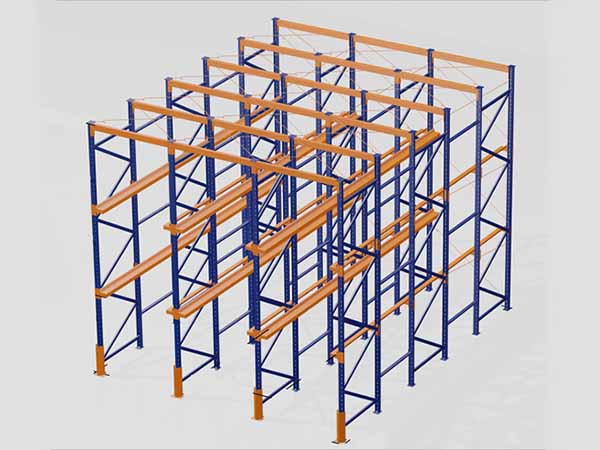
Warehouse shelves are essential for efficient storage and retrieval of goods. Choosing the right type of shelving can significantly impact your warehouse's productivity and space utilization. Here's a comprehensive classification of warehouse shelves, categorized by structure and load capacity:
Classification by Structure
- Beam Type Shelving:
- Description: This is the most common type of shelving, consisting of vertical columns and horizontal beams. Pallets or other items are placed on the beams.
-
Advantages:
- Fast and convenient access to all items.
- First-in, first-out (FIFO) inventory management.
- No restrictions on forklift types.
- Fast delivery speed.
-
Disadvantages:
- Space utilization rate is relatively low (30%-50%).
- Suitable for: Palletized goods, various industries.
- Corridor Type Shelves:
- Description: These shelves are designed for high-density storage, with aisles only wide enough for forklifts to pass through.
-
Advantages:
- High storage capacity.
- Can accommodate large quantities of similar items.
-
Disadvantages:
- Access to items can be slow.
- Not suitable for FIFO inventory management.
- Suitable for: Storing large quantities of homogeneous goods.
- Gravity Shelves:
- Description: These shelves use gravity to move items from the back of the rack to the front, making them ideal for FIFO inventory management.
-
Advantages:
- High density storage.
- High efficiency of goods storage.
- Fast retrieval of goods.
-
Disadvantages:
- Higher initial cost.
- Suitable for: High turnover items, distribution centers.
- Attic Shelves:
- Description: These shelves utilize the vertical space in a warehouse by creating multiple levels (usually 2-3 floors).
-
Advantages:
- Increased storage capacity.
- Suitable for light and small goods.
-
Disadvantages:
- Manual access can be time-consuming.
- Suitable for: Warehouses with high ceilings, storing light and small goods.
- Cantilever Shelves:
- Description: These shelves are designed for storing long and irregular items, such as pipes, lumber, and furniture.
-
Advantages:
- Easy access to long and bulky items.
- Customizable to fit specific needs.
-
Disadvantages:
- Can take up a lot of space.
- Suitable for: Storing long and irregular items.
- Electronic Control Mobile Shelves:
- Description: These shelves are mounted on tracks and can be moved electronically to create aisles for access.
-
Advantages:
- High density storage.
- Efficient use of space.
-
Disadvantages:
- Higher initial cost.
- Suitable for: Warehouses with limited space.
- Pallet Shelves:
- Description: These shelves are designed specifically for storing palletized goods.
-
Advantages:
- Easy handling of palletized goods.
- Can be used with various types of forklifts.
-
Disadvantages:
- Requires the use of pallets.
- Suitable for: Warehouses that handle a large volume of palletized goods.
Classification by Load Capacity
- Light Shelves:
- Description: These shelves are designed for storing light items, with a maximum load capacity of 150-250 kg per layer.
-
Advantages:
- Easy to assemble and disassemble.
- Adjustable height.
-
Disadvantages:
- Not suitable for heavy items.
- Suitable for: Storing small parts, documents, and other light items.
- Medium Shelves:
- Description: These shelves can bear 300-500 kg per layer and are suitable for storing medium-weight items.
-
Advantages:
- Versatile and adaptable.
- Adjustable height.
-
Disadvantages:
- Not suitable for very heavy items.
- Suitable for: Storing a variety of items, from small parts to medium-sized boxes.
- Heavy Duty Shelves:
- Description: These shelves are designed for storing heavy items, with a single layer capacity of 1-3 tons.
-
Advantages:
- Strong and durable.
- Can be used with pallets or wire mesh decking.
-
Disadvantages:
- Higher cost compared to light and medium shelves.
- Suitable for: Storing heavy items, palletized goods.
Shelf Technology and Safety Factors
- Material: Shelf components are made of rolled steel plates that meet industry standards for strength and rigidity.
- Welding: Carbon dioxide gas shielded welding, automatic welding.
- Surface Treatment: Accessories undergo oil removal, rust removal, pickling, and phosphating before powder coating. 180° EPOXY powder coating, typically 60-80 microns thick.
- Load Capacity: The bending proportion of the beam after bearing is 1:200 of the length, with a tolerance of 10%. The safety factor after bearing is 1.5 times.
Choosing the Right Shelving System
Selecting the right shelving system for your warehouse depends on various factors, including:
- Type of goods: Size, weight, and shape of the items you need to store.
- Storage capacity: The volume of goods you need to store.
- Inventory management: Whether you need FIFO or other inventory management methods.
- Warehouse space: Dimensions and layout of your warehouse.
- Budget: Cost of the shelving system and installation.
By carefully considering these factors and consulting with a reputable shelving supplier, you can choose the perfect shelving system to optimize your warehouse operations and maximize your storage space.
Need a Custom Storage Solution?
Speak directly with our technical engineers. We offer free structural designs, heavy-duty catalog evaluations, and quick B2B price quotations.
Request a Quote Now →