 |
In a demanding industrial workshop or high-traffic warehouse, the term "heavy duty" is often misused. A true industrial workshop cart is not just a two tier cart on wheels; it's a piece of engineered equipment. The difference lies in the unseen details: the quality of the steel, the method of its construction, and the intelligence of its design features. These details determine whether a cart is a reliable asset or a short-term liability.
|
The Foundation: Material and Construction
A cart's strength begins with its frame. A light-duty cart often uses thin, bolted-together angle iron. An industrial-grade cart starts with high-quality Q235 structural steel, known for its excellent weldability and strength. This material is formed into robust 30x30mm rectangular tubing.
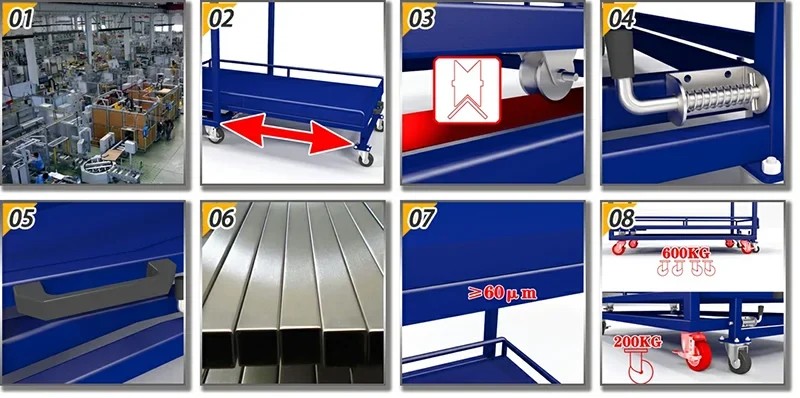
This frame isn't bolted; it's unified using CO2 gas-shielded welding (MIG/MAG). This process creates deep, full-penetration welds that are stronger than the surrounding metal, resulting in a single, rigid chassis. This is why it can be rated for a 600kg load capacity—the construction method ensures it can handle sustained, heavy use without flexing, warping, or failing at the joints.
The Finish: Durability Beyond Paint
In a workshop, carts are constantly hit, scraped, and exposed to chemicals. Standard paint chips easily, exposing the steel to rust and degradation. A professional tool uses electrostatic spraying (powder coating). This process involves electrically charging the powdered pigment, which is then drawn to the grounded steel frame. It's baked on, creating a thick (often $ge 60mutext{m}$) , uniform, and incredibly durable finish. This coating is far more resistant to chipping, scratching, and chemical corrosion, protecting the steel and extending the asset's life significantly.
The Details: Intelligent, Purpose-Driven Design
Beyond the core construction, it's the small design features that prove a cart was built by engineers who understand the work environment:
- Inner-Lined Latch Pin: Many carts have external bolts or pins that stick out, snagging clothing, boxes, or equipment. An inner-lined latch pin sits flush with the frame, providing a secure lock for the pull-out shelf without creating an external hazard.
- Guided V-Wheel System: A simple drawer pull-out can wobble, jam, or de-rail under load. A true industrial design uses a V-wheel that runs on a perfectly aligned angle steel guide rail. This ensures the shelf slides smoothly and predictably, even with hundreds of kilograms on it.
- Ergonomic Handles: The handle isn't just for pushing. A high-quality, comfortable plastic handle provides positive grip and control, which is essential for safely maneuvering a 600kg load around tight corners and valuable machinery.
| Talk With An Expert |
An Asset, Not a Consumable
A cheap, light-duty cart is a consumable item you expect to replace. A cart built with Q235 steel, industrial welding, powder coating, and intelligent design features is a long-term capital asset. It's a tool engineered to provide a lower total cost of ownership through years of reliable, safe performance in a true industrial environment.
Frequently Asked Questions
What is Q235 steel and why does it matter for a cart?
Q235 is a high-quality carbon structural steel. Unlike simple sheet metal, it provides the high strength and excellent weldability needed for a cart's frame to be rated for a 600kg load and to withstand industrial use.
How is powder coating different from regular paint?
Powder coating is thermally bonded to the metal, creating a much thicker, harder, and more durable finish. It is far more resistant to chipping, scratching, and rust, which is essential in a workshop environment.
What is the purpose of an "inner-lined latch pin"?
It securely locks the pull-out shelf in place during transit. By being "inner-lined" (flush with the frame), it eliminates the snag hazard of external bolts or handles, which can catch on clothes or equipment.
What is a V-wheel and angle rail system?
This is an industrial guide system. The V-shaped wheel runs along a matching angle steel track, which keeps the pull-out shelf perfectly aligned. This prevents jamming and ensures it can slide smoothly even with heavy weight on it.
Why does a welded frame matter?
A fully welded frame (using processes like CO2 gas-shielded welding) creates a single, rigid unit. A bolted frame has many failure points, will loosen (wobble) over time, and cannot safely support the same amount of weight.
Need a Custom Storage Solution?
Speak directly with our technical engineers. We offer free structural designs, heavy-duty catalog evaluations, and quick B2B price quotations.
Request a Quote Now →