 |
It's easy to see an industrial workshop cart as a simple product. But a truly industrial tool is a *system* where every component is engineered to support the others. A 600kg load capacity is not just about a strong shelf; it's about a complete system designed to manage that load safely through every phase: loading, transport, and unloading. |
The Flaw in "Feature-Based" Design
Many carts are designed by "adding features"—a pull-out shelf, a handle, some wheels. This often results in a disconnected product. The pull-out shelf is wobbly. The handle is uncomfortable. The wheels are too small for the "rated" load. This is because the components weren't designed to work together.
A Cart Engineered as a Cohesive System
A superior 2 tier cart on wheels is designed as a single system. The ergonomic access is supported by the stability, which is ensured by the security, which is all built on a robust foundation. Here’s how the sub-systems work together:
1. The Loading System: Access + Stability
The pull-out shelf doesn't just slide out. It's an engineered "access system."
- V-Wheels on Rails: These ensure the shelf tracks smoothly, preventing the binding and wobbling that plagues simple drawer slides.
- Auxiliary Casters: These provide the *stability*, transferring the 300kg load to the floor, not the frame.
This system *as a whole* creates a stable, ergonomic platform that allows for safe top-down access. One feature without the other would fail.
2. The Transport System: Security + Foundation
Once loaded, the cart becomes a "transport system."
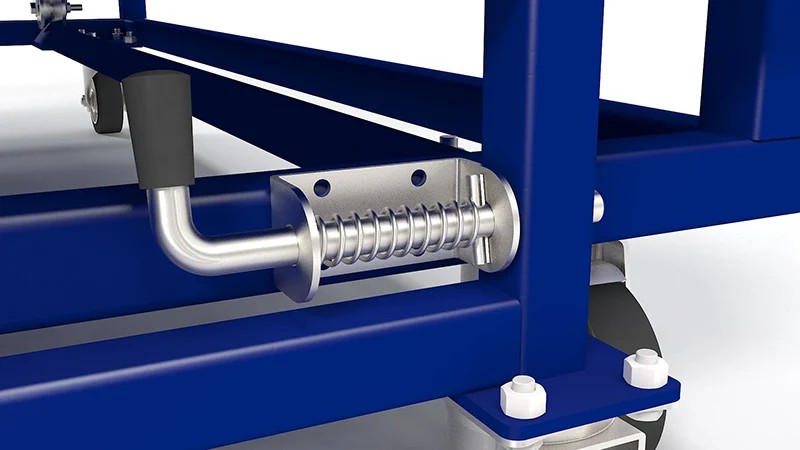
- Lining Latch Pin: This component locks the pull-out shelf to the frame, converting the cart into a single, solid unit. This is critical for preventing the 300kg shelf from sliding open during a sudden stop.
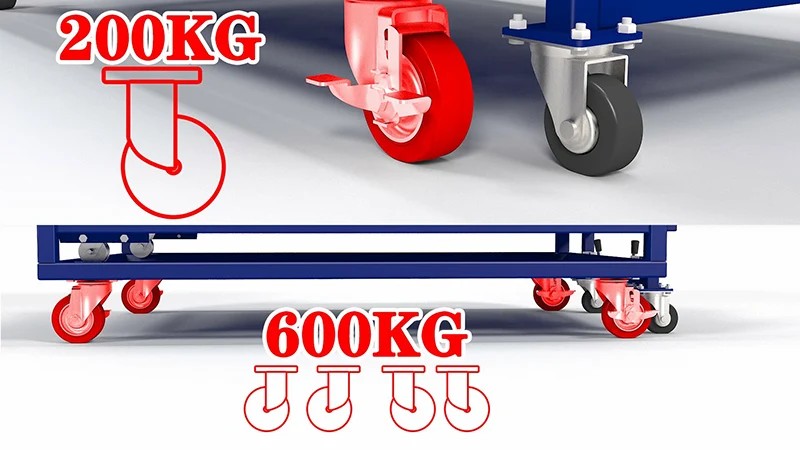
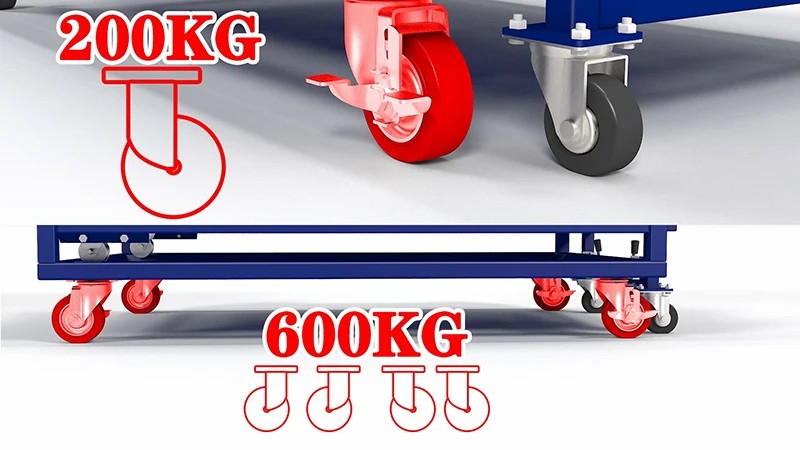
- Q235 Steel Frame: The fully welded Q235 frame provides the rigid foundation that absorbs the dynamic stress of a 600kg load in motion.
- Polyurethane Casters: These industrial wheels ensure the entire system rolls smoothly and quietly, absorbing shocks that would otherwise damage the frame or load.
This system ensures the load is stable and secure from point A to point B.
Buying a System, Not a Product
When you look at a 2 tier trolley on wheels through this lens, you stop seeing features and start seeing systems. You see a "Loading System" that prioritizes ergonomics and a "Transport System" that prioritizes safety. This integrated design is the only way to create a tool that is reliable, safe, and efficient for its entire service life.
Frequently Asked Questions
Q: What does a "systems approach" to cart design mean?
A: It means all components (wheels, frame, slides, latches) are engineered to work together to achieve a goal—like safe transport. This is different from just adding features (like a slide) that may not be properly supported by the rest of the design.
Q: How do the V-wheels and auxiliary casters work together?
A: The V-wheels on their rail *guide* the shelf so it moves in a perfectly straight, smooth line. The auxiliary casters *support* the load, making the extended shelf a stable platform. One provides precision, the other provides strength.
Q: Why is a latch pin necessary if the slide is smooth?
A: A smooth slide is a hazard during transport. The latch pin is part of the "transport system," ensuring the 300kg shelf stays locked and secure, preventing it from sliding open and causing an accident.
Q: Is the 600kg capacity a system rating?
A: Yes. It's not just that the shelves are strong. It means the Q235 frame, the CO2 welds, and the Polyurethane casters are all engineered *together* to safely handle a 600kg dynamic load.
Q: Can I get just the pull-out shelf without the latch?
A: A properly designed system would not offer this, as it would be unsafe. The ergonomic loading system (pull-out shelf) must be paired with the safety transport system (latch) to be a complete, professional solution.
Need a Custom Storage Solution?
Speak directly with our technical engineers. We offer free structural designs, heavy-duty catalog evaluations, and quick B2B price quotations.
Request a Quote Now →